
A powerful, adaptable, and scalable web hosting solution, a Cloud Virtual Private Server (Cloud VPS) uses cloud computing to establish a dedicated virtual environment. A cloud VPS is powered by a cluster of linked servers, as opposed to traditional VPS hosting, which operates on a single physical machine. This architecture is a great option for expanding companies that need more resources than shared hosting but aren’t ready for a full dedicated server because it provides better dependability, instant scalability, and a pay-as-you-go pricing model.
What is a Cloud VPS Server?
A virtual server hosted on a cloud infrastructure that offers specific resources like CPU, RAM, and storage is known as a cloud VPS (Virtual Private Server). With separate environments for every user, a Cloud VPS provides superior performance, control, and scalability in compared to shared hosting, where resources are shared among users.
Cloud VPS vs Shared Hosting vs Dedicated Server
| Feature | Shared Hosting | Cloud VPS Server | Dedicated Server |
|---|---|---|---|
| Speed | Low (shared resources) | Medium to High (dedicated allocation) | Very High (full resources) |
| Cost | Low | Moderate | High |
| Control | Limited | High (root access) | Full control |
| Scalability | Limited | High (easy to scale resources) | Moderate (hardware dependent) |
When to apply each:
- Shared hosting is ideal for novices, small websites, or low-traffic blogs with nothing in the way of technological needs.
- Cloud VPS servers are perfect for expanding companies, e-commerce websites, and apps that require increased scalability, flexibility, and performance.
- Dedicated servers are ideal for high-traffic platforms, big businesses, and applications that need complete hardware control, security, and optimal performance.
How Does a Cloud VPS Work?
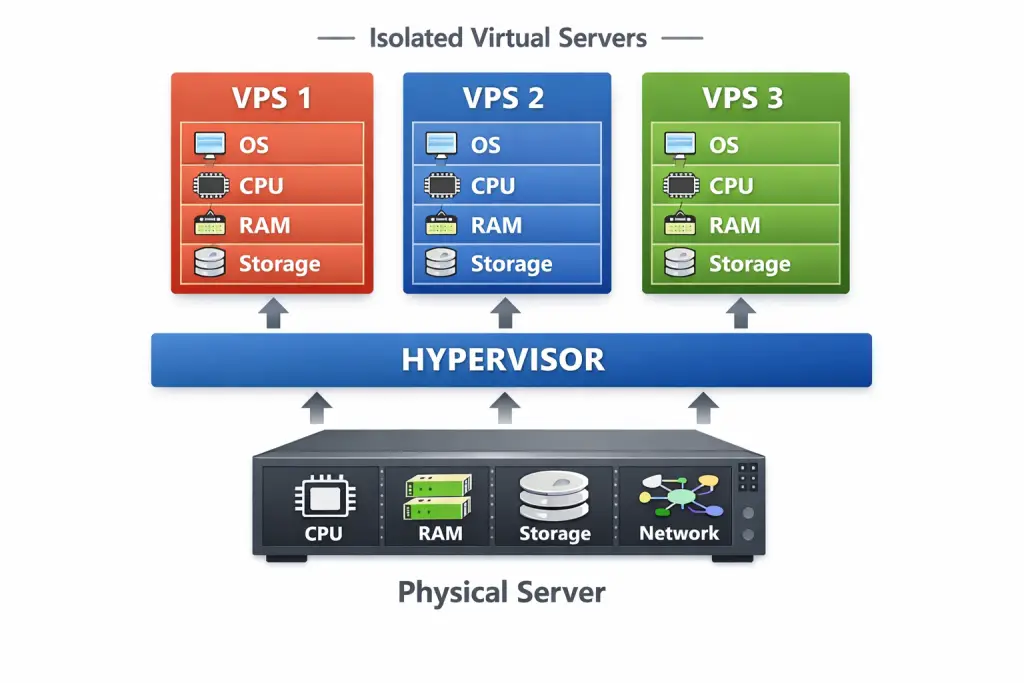
A single physical server is split up into several separate virtual servers using virtualisation technology, which is how a cloud VPS operates. With its own operating system, storage, CPU, and RAM, each VPS functions as a separate computer.
A hypervisor, which is software that stands between the hardware and virtual machines, is at the center of this configuration. By assigning specific percentages of server resources to each user, it establishes and maintains several VPS instances. This guarantees performance isolation, preventing other VPSs on the same physical server from being impacted by one.
The dynamic distribution of resources like CPU, RAM, and disc space makes it simple to scale in response to demand. Because of this, Cloud VPS is more dependable and adaptable than traditional hosting.
Key Benefits of Cloud VPS for Businesses
A Cloud VPS provides a robust combination of cost and performance benefits that make it a highly recommended solution for modern businesses, especially in a growing digital economy like Nepal.
Performance:
With a Cloud VPS, you can run your applications with greater speed and reliability due to exclusive access to CPU, RAM, and storage. This is particularly important for businesses with websites and web applications.
Scalability:
With a Cloud VPS, you can scale your server resources instantly to accommodate your growing business. This will help you scale your server resources to meet your growing business demands.
Cost Efficiency:
A Cloud VPS offers enterprise-grade performance at a fraction of the cost of a dedicated server. With a Cloud VPS, you only pay for what you actually use.
Security and Isolation:
A Cloud VPS runs in an isolated environment to reduce security risks from other users. In addition to this, a Cloud VPS also offers full control to configure security features according to your business needs.
Nepal Context (Latency & Payments):
For businesses targeting Nepal, it is recommended to choose a VPS closer to Asia, such as Singapore or India, which would minimize latency and reduce the load time of websites. This is particularly important for businesses using local payment gateways such as eSewa and IME Pay, where the efficiency of the website is critical for the smooth execution of payments.
Who Should Use a Cloud VPS?
A Cloud VPS is perfect for users and businesses that have outgrown their shared hosting and require better performance, flexibility, and control.
E-commerce Businesses:
E-commerce businesses require fast page loads, secure transactions, and high uptime. A Cloud VPS will help your business perform smoothly during peak traffic and ensure smooth transactions for your customers.
SaaS Applications:
SaaS applications require scalable infrastructure and smooth performance. A Cloud VPS will help your developers deploy, test, and scale your applications easily.
Digital Agencies & Developers:
Digital agencies require isolated environments and full control. A Cloud VPS allows developers to configure the server, install custom software, and control everything easily.
Development & Staging Environments:
A Cloud VPS is perfect for testing your applications before deploying them live. You can create development environments and test your applications before deploying them live.
In short, if your project requires better performance, scalability, and customization, then a Cloud VPS is the perfect choice for your project.
How to Choose the Right Cloud VPS Provider
Selecting the appropriate Cloud VPS service is vital for the success of your business. Rather than concentrating on the price factor, it is recommended that you look into the specifications of the service.
Key Specs to Look For
CPU & RAM (Performance):
Select a plan that provides dedicated CPU cores and RAM according to your business needs. For instance, a small business website may require 2-4 GB of RAM, whereas a business like eCommerce or SaaS may require 8 GB of RAM or higher for optimal performance.
Storage Type (Speed):
Always look for a plan that provides SSD or NVMe storage. NVMe drives have higher read/write speeds compared to traditional drives, resulting in a faster website loading time.
Scalability:
Ensure that the provider supports upgrade facilities like CPU, RAM, and storage without any downtime. This facility is required for a business that is growing dynamically.
Uptime & Reliability:
Ensure that the provider provides a minimum of 99.9% uptime guarantee through strong infrastructure and data centers. This ensures the availability of your website at any time.
Bandwidth & Network:
It is also important to check the bandwidth and network speeds, such as a 1 Gbps port. High traffic websites require more bandwidth or unlimited plans.
Control & Access:
It is also important to check for full root access and support for control panels such as cPanel and Plesk.
Support & Management:
24/7 support is also important, especially when it comes to business-critical applications. Managed VPS is also useful.
Why Choose Bisup Cloud VPS for Your Business?
If you are looking for a high-performance solution with the option to scale with your business, then Bisup Cloud VPS is the way to go as it offers:
- High-performance NVMe servers
- Ability to scale with your business
- High-security features with high reliability
- Root access with developer-friendly features
- Optimized servers with region focus
Explore our plans and find the perfect fit for your business needs with Bisup Cloud VPS.